
Why Vertical Integration Is Key to Win in this New Economy
Why Vertical Integration Is Key to Win in this New Economy
By Sota Watanabe (CEO of Startale Group) Startale's mission is to build the next civilization by bringing the world onchain.
We are convinced that over the next 10 to 20 years, a structural shift will occur in which the foundations of humanity's economic, social, and cultural activities migrate onto the blockchain (going onchain). Just as paper-based transactions gave way to online transactions, online transactions will evolve into onchain transactions. And that shift will accelerate as three technologies converge: AI (Artificial Intelligence), Blockchain, and Crypto. We call them ABC.
The relationship can be expressed as:
AI × Blockchain × Crypto = D (Digital Civilization)
It's almost certain that AI and blockchain will become increasingly intertwined, and that crypto will play a central role in the economy of AI agents. We want to build the civilizational infrastructure for that future.
This article lays out the strategy Startale has been executing since 2023 to make that happen: vertical integration.
What Vertical Integration Means, and Why Startale Chose This Path
The blockchain and crypto industry has many players. Some focus on infrastructure. Others specialize in application development. Some are consultancy-first. The standard approach is to go deep in one area.
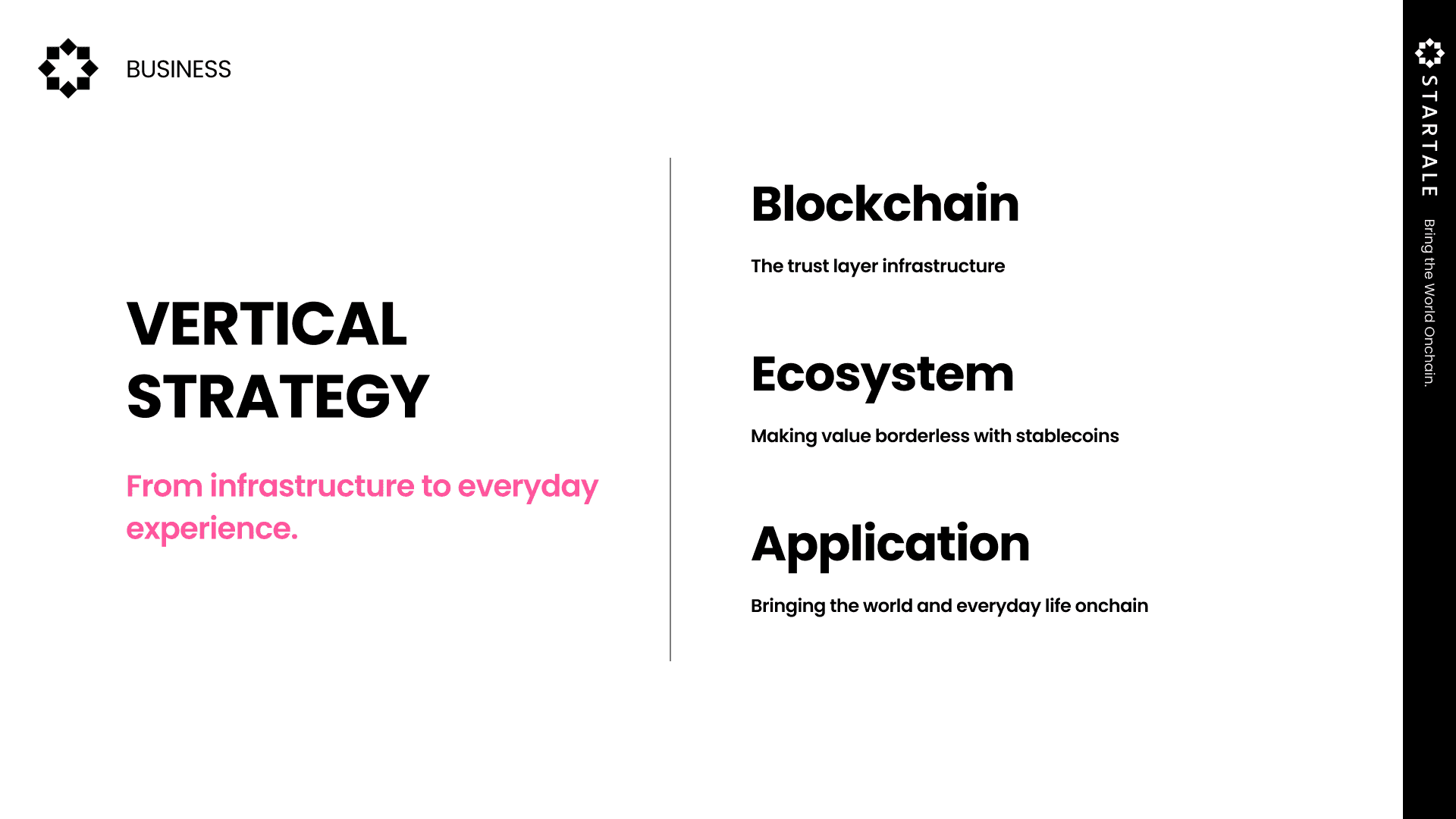
Startale chose differently. We chose vertical integration: building across the full stack, from the infrastructure layer to the application layer, in a single, end-to-end operation.
 The horizontal, modular approach that has defined crypto so far is rooted in open-source principles, and it worked well for accelerating innovation. But it also created a fundamental flaw: friction between layers kept breaking the user experience. Bridges introduce hack risks. Gas fee structures vary wildly across chains, making it impossible for users to know where to transact cheaply. Wallet complexity drives most people to give up entirely. All of this is "connection cost" produced by horizontal fragmentation.
As crypto moves toward mass adoption, this fragmentation becomes a critical bottleneck. Many companies are now pivoting to vertical integration. Look at Coinbase. Look at Circle. Startale saw this coming in 2023 and has been building accordingly ever since.
Startale's Business Structure: Three Layers
To bring vertical integration to life, Startale operates across three business domains.
Blockchain
We build three chains: Soneium, Strium, and Astar.
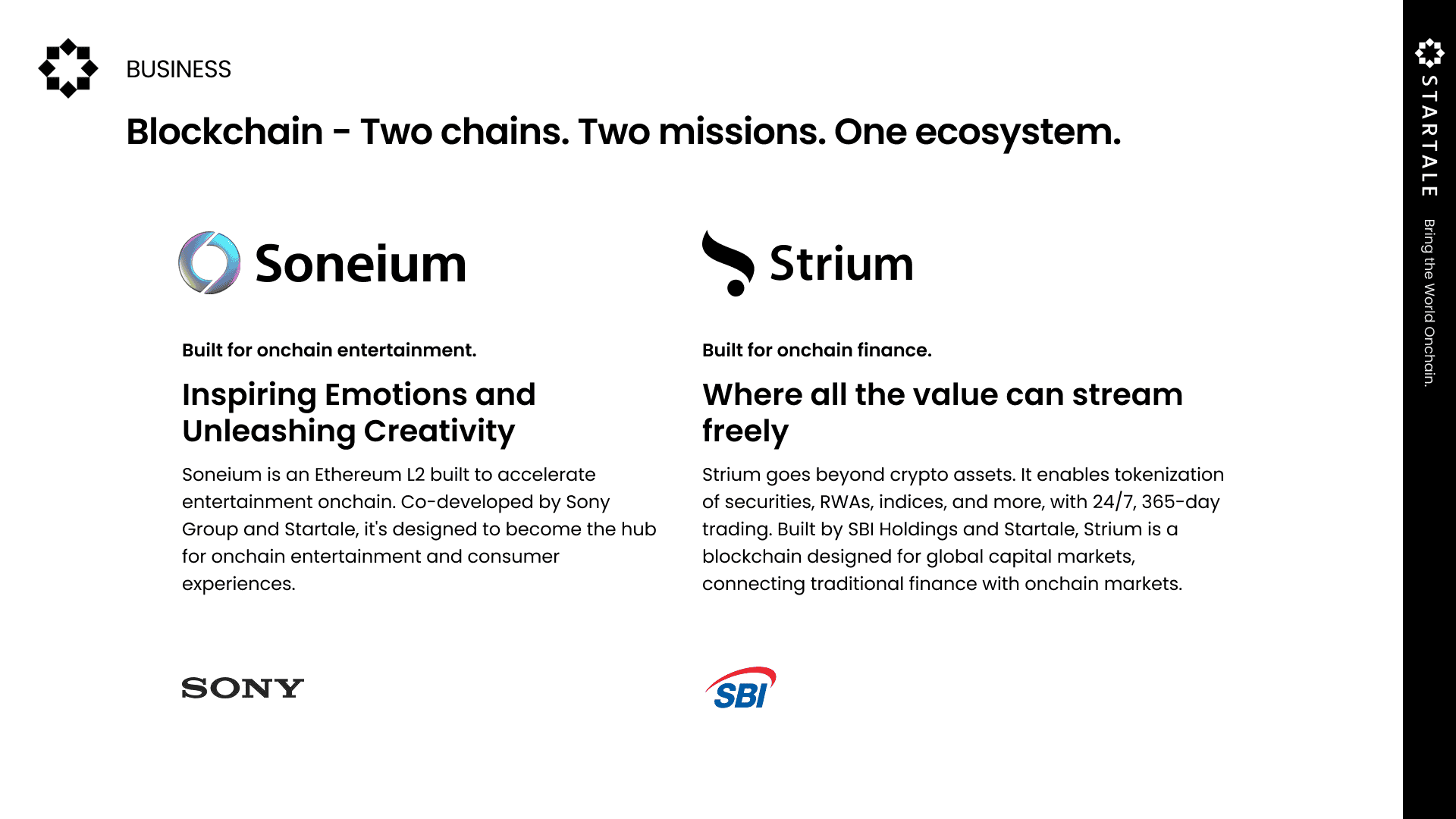
The chain is the foundation of everything. We're building that foundation around the two areas most central to human economic activity: finance and entertainment.
Ecosystem
On the ecosystem layer, we provide developer tools through Startale Cloud, including Account Abstraction, Chain Abstraction, and Node services. On the user side, we've created stablecoins denominated in Japanese yen and U.S. dollars. Our biggest focus here is JPYSC, the Japanese yen stablecoin we're developing with SBI Holdings.
Application
Because vertical integration is the strategy, our applications are designed to maximize synergy with our chains, stablecoins, and developer tools. Right now, the primary focus is the Startale App, an integrated wallet.
The Startale App lets users log in with a Web2 ID like Gmail. The design ensures they never need to think about whether Soneium or Strium is running underneath. But it's more than a wallet for managing assets. We plan to add applications (Mini Apps), credit card functionality, and social features over time. The end goal is a crypto super-app.
The Competitive Advantage of Vertical Integration
From the long-term perspective of building civilizational infrastructure, Startale believes vertical integration is the only correct answer.
The iPhone was revolutionary because it unified hardware, software, and services into one experience. Tesla is transforming the automotive industry because it vertically integrates batteries, motors, software, and charging infrastructure.
In the short term, this strategy appears to contradict the management principle of "focus and specialization." This is where a strategic partnership becomes essential. You implement the layers where you're strong, and you fill the gaps through collaboration. That way, you assemble the full stack without sacrificing focus. SBI Holdings is an ideal partner in this regard.
 [Image: Kitao-san's presentation materials at MoneyX]
As this makes clear, Startale and SBI have a complementary relationship.
The competitive advantage of vertical integration goes beyond UX improvements. The most powerful benefit is the ability to shift where you monetize. When you can generate profit across the entire stack, you don't need to extract margin from any single layer. Where competitors with only one layer are forced into price wars, Startale can offer that layer for free or at low cost and recapture value elsewhere. This is a move that single-layer players simply cannot make. Competing as an entire ecosystem, as a system: that is the essential strength of vertical integration.
Looking Five Years Ahead
Power grids. Telecommunications networks. Road systems. Every piece of infrastructure humanity has built was realized because an entity with a vision for the whole system took responsibility for it. Stacking partial optimizations alone has never produced civilizational infrastructure.
History shows that early-stage industries always begin in horizontal, fragmented chaos. The American electrical power industry in the late 19th century is a perfect example. Edison's direct current and Westinghouse's alternating current (backed by Nikola Tesla) competed in parallel, with different standards, voltages, and frequencies in every city. It was the intervention of an entity with a vision for the whole system, J.P. Morgan, that resolved this "connection cost." Only when the power grid was reorganized under the unified standard of AC transmission did electricity become civilizational infrastructure.
The internet followed the same pattern. The fragmented networks that grew out of ARPANET were isolated islands, unable to connect, until TCP/IP provided a common protocol. The moment TCP/IP unified communications infrastructure under a single system-level design, the Internet became the foundation of civilization.
The lesson from history is clear: it's not the superior technology (DC vs. AC) that wins. It's whoever builds the system that minimizes connection costs and makes the whole thing usable for society. Parts don't naturally cohere into a whole. The team that achieves full integration through vertical integration and delivers the ideal experience is the one that defines the era.
Horizontal fragmentation drives innovation. But for something to become civilizational infrastructure, an entity with the will must eventually emerge and the responsibility to design the whole. Startale is choosing, deliberately, to be that entity.
Original note from Sota Watanabe: https://x.com/SotaOnchain/article/2029275596845359130